Technical / research - Page 3

Researchers develop flexible wireless brain implant, that uses microLEDs to emit patterned light through the skull to activate neurons

Researchers at Northwestern University have developed a flexible wireless brain implant, that uses microLEDs to emit patterned light through the skull to activate neurons and deliver information directly to the brain.

This new device is less invasive than previous designs, and its flexibility means that it can conform to the surface of the skull and shine light through the bone, to the brain. 

Read the full story Posted: Dec 15,2025

Researchers utilize microLEDs to develop a novel pancreatic cancer treatment

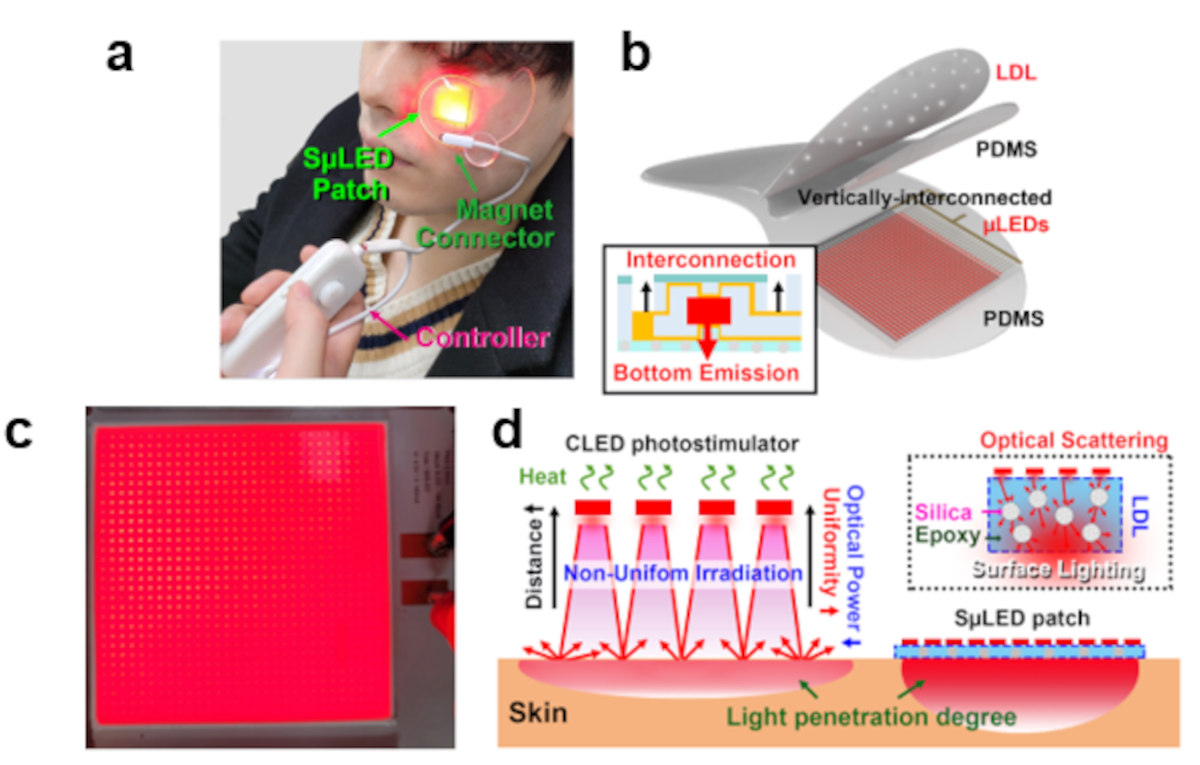
Researchers from Korea's KAIST institute, in collaboration with colleagues from UNIST, have utilized microLEDs to created a new photodynamic therapy for pancreatic cancer treatments based on microLEDs, that may overcome a critical hurdle in current treatment options.

The researchers explain that pancreatic tumors have a biological barrier due to the dense tumor microenvironment (TME). This barrier surrounds the tumor, severely limiting the infiltration of chemotherapy agents and immune cells.  Current photodynamic therapy methods are promising, but the currently used light sources fail to penetrate deep tissues.

Read the full story Posted: Dec 13,2025

Researchers develop a promising memristor-based active-matrix microLED driving circuit

Researchers at Korea University led by Prof. Tae-Geun Kim have developed an active-matrix microLED driving circuit, powered by a single memristor. The idea is that each sub-pixel is powered by the germanium-based memristor, without the need for any storage capacitor.

The researchers built a 12x12 microLED array, powered by the memristor. The memristor's resistance directly controlled LED brightness with excellent stability. The process, which is compatible with existing display manufacturing processes, is the first experimental demonstration of a capacitor-free active-matrix microLED pixel.

Read the full story Posted: Nov 08,2025

Researchers deposit cMOFs on microLEDs to enable sensitive chemiresistive gas sensing at room temperature

Researchers from the KAIST institute, in collaboration with colleagues from Korea University, Korea Basic Science Institute and Chung-Ang University, have developed a novel way to achieve chemiresistive gas sensing, using CMOFs on microLEDs.

The researchers integrated electrically conductive metal-organic frameworks (cMOFs), a promising chemiresistors due to their diverse compositions, chemical properties, porosity, and room-temperature conductivity, on top of microLEDs using a layer-by-later method. This solves the low sensitivity problem of cMOFs, and enables photoactivated gas sensing even at room-temperature.

Read the full story Posted: Oct 31,2025

Researchers from BOE improve microLED light output by adopting a novel package scheme

Researchers from BOE reported on a new microLED package design, that improves light output from microLED displays. 

The new design combines a high-refractive-index transparent adhesive, a high-reflectivity white adhesive and a microlens array. This new design increases light output, and uses the sidewall emission to significantly improve the optical efficiency of microLED displays. In addition to the adhesives and MLA, the researchers adopted a patterned design of the black matrix (BM) cover plate to further reduce light loss and improves the contrast. The result is a highly efficient display with an improved image quality. 

Read the full story Posted: Oct 16,2025

CEA Leti to present its graphene-based microLED deposition method at MicroLED-Connect 2025 next week

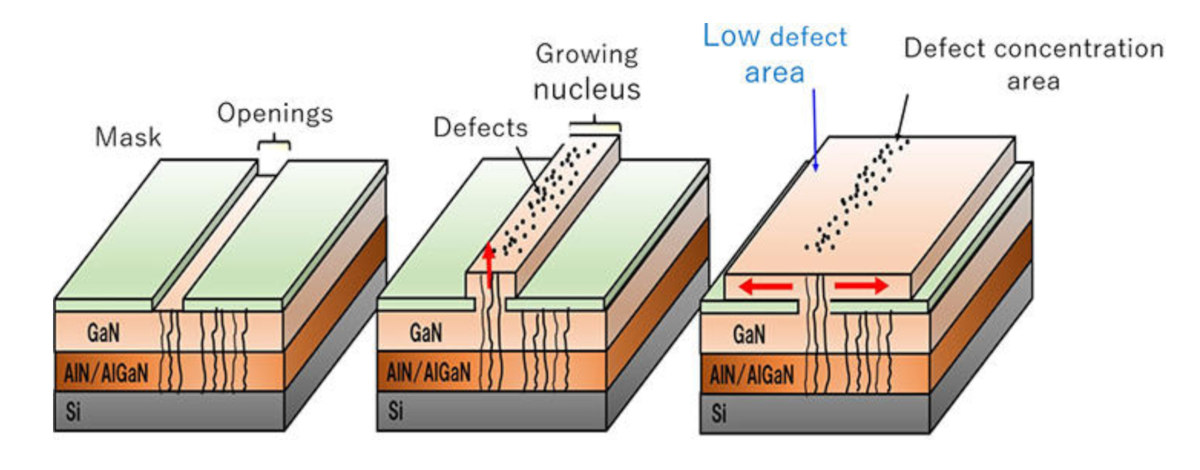
Towards the end of 2024 we reported that researchers at CEA-Leti together with colleagues from CNRS have developed a new technique to grow high-quality InGaN-based quantum wells on sub-micron nanopyramids, using graphene on silicon carbide serving as a selective mask.

CEA-Leti and CNRS develop sub-micron nanopyramid microLEDs devices

The lead researcher Amélie Dussaigne will present this exciting research at MicroLED-Connect 2025, taking place next week in Eindhoven, The Netherlands. CEA-Leti considers this a breakthrough research as it enables native RGB emission from a single material system, while supporting chip sizes under 10 micron - suitable for AR/VR microdisplays.

Read the full story Posted: Sep 16,2025

Microsoft researchers use microLEDs to build an analog optical computer

A Microsoft Research team, based in Cambridge UK, has successfully created an analog optical computer (AOC), that uses light as a medium for solving complex problems. The light in Microsoft's AOC is generated by microLEDs. 

Unlike a typical binary digital computer, an AOC uses physical systems to embody the computations it performs, avoiding some fundamentally limiting aspects of digital computing. Microsoft's vision is that such a device could be 100 times faster and 100 times more energy efficient in solving certain problems compared to digital computers.

Read the full story Posted: Sep 06,2025

Researchers develop starfish-inspired adhesive technology suitable for microLED transfer processes

Researchers from the Seoul National University of Science and Technology (SEOULTECH) have designed a new adhesive technology, inspired by starfish. The researchers say that this new adhesive effectively and efficiently grips and releases objects underwater.

But its applications range beyond underwater use - the researchers mention microLED transfer as a possible use case. It doesn't seem as if they have actually started developing any microLED related technology, though.

Read the full story Posted: Aug 28,2025

Researchers study the use of graphene films for microLED heat dissipation

Researchers from Shanghai University have studied the use of graphene heat dissipation films on microLED devices, with the goal of optimizing the microLED thermal management scheme, improving the photoelectric conversion efficiency and reducing the effect of high junction temperature on the performance and reliability of the device. 

The researchers are also studying the role of solar radiation. Research has shown that when the sun’s rays are directed into the microLED device, its surface radiation will increase dramatically, which can provide the corresponding basis for solving the problem of sunlight backflow.

Read the full story Posted: Aug 28,2025