Wearables

The wearable market is one of the first key markets for microLED display developers. MicroLEDs will enable high quality displays, that would offer very high brightness and efficient, which will be very useful for smartwatch developers. The limited resolution (number of pixels) of wearable displays also make this market suitable for early microLED adoption.

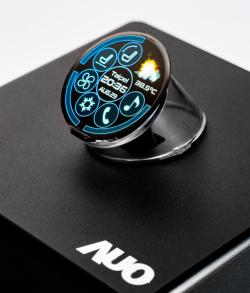
AUO 1.39-inch 338 PPI MicroLED display, (Touch Taiwan 2021)

Several companies are developing microLED wearable displays, aiming to replace OLEDs in premium devices. The most advanced project seems to be AUO's - which already announced it has a commercial microLED wearable display towards the end of 2023. According to reports, the first company to adopt AUO's smartwatch microLED displays will be Tag Heuer in 2024.

Apple is reportedly also working towards adopting a microLED display in a future smartwatch device. The company originally hoped to launch the first such device in 2023, but the project has been delayed several times.

The latest wearable microLED news:

The MicroLED Industry Association publishes a microLED wearable displays white paper

The MicroLED Industry Association published a new white paper that provides a technology, market and roadmap assessment of microLED displays for smartwatches and other wrist-worn devices. A summary edition of the white paper is openly available to download here.

MicroLED Wearable Displays white paper cover

In September 2025, Garmin shipped the Fenix 8 Pro MicroLED, the first commercial consumer product of any kind with a microLED display. Reviewers were near-unanimous that it is the best-looking smartwatch screen ever made, but battery life falls from 27 days to 10 days in smartwatch mode compared to the AMOLED version, and the display draws on the order of three times the power. The white paper argues that this is a system-integration gap, and not a refutation of the technology.

Read the full story Posted: Nov 09,2026

Garmin explains why its new Fenix 9 Pro has no microLED version: not enough suppliers, and no ramp-up in several sizes

Garmin's COO, Brad Trenkle, explained in a recent interview why the company's new Fenix 9 Pro smartwatch family does not have a microLED version. The main reason is supply: there are not enough microLED display suppliers yet, and the supply chain cannot yet produce microLED panels in several sizes, in the volumes that Garmin needs.

Garmin Fenix 8 Pro MicroLED vs Fenix 9 Pro: 51 mm only vs 43, 47 and 51 mm, 4,500 vs 3,000 nits, 1.4 vs 1.5 inch, 17.5 vs 15.8 mm thick, up to 10 vs up to 31 days of battery, $1,599 vs $1,299

"We do see the potential for microLED to continue, but one of the key challenges we have is the amount of supply chain diversity and the ability for the supply chain to ramp up to support the needs of our customers," Trenkle said.

Read the full story Posted: Nov 07,2026

Garmin has no immediate plans to release a new microLED watch, as AMOLEDs seem to be good enough

In September Garmin launched its Fenix 8 Pro MicroLED smartwatch, the world's first with a microLED display. The panel is a 1.4" 454x454 round display that offers a brightness of 4,500 nits, produced by AUO.

The Garmin Fenix 9 Pro OLED watch

The company recently launched the next-generation Fenix 9 Pro smartwatch family, without a microLED option. The display is an AMOLED display, with a brightness of 3,000 nits. We did not know whether the company plans to release a microLED edition, but in a recent statement Garmin said: "MicroLED is an exciting emerging technology that continues to evolve. While it played an important role in the fēnix 8 Pro 51mm lineup, we’re excited for the opportunity to bring our brightest and largest 1.5″ AMOLED screen to fēnix 9 Pro 51mm. We will always monitor advancements in display technology and will look to bring those to the Fenix lineup when they make sense".

Read the full story Posted: Sep 19,2026

PlayNitride updates on its optical I/O projects, confirms its chips power the Garmin Fenix 8 Pro and Samsung microLED TVs, details its new Tantium microLED display platform

Taiwan-based MicroLED developer PlayNitride held its Q2 2026 investor conference call, during which it updated on its financials - and also on its major projects and customers. PlayNitride reported revenues of 150 million TWD ($4.7 million USD), down 26% from Q2 2025 ($6.3 million) and slightly up then the first quarter of 2026 ($4.4 million).

First, PlayNitride says that its current business is quite steady. It is supplying microLED chips to both Samsung's direct-emission microLED TVs, and also to the Garmin Fenix 8 Pro smartwatch (produced by AUO). 

Read the full story Posted: Sep 04,2026

Samsung announces a 5,000 nits OLED smartwatch, surpassing AUO's 4,500 nits microLED

In September 2025 Garmin launched its Fenix 8 Pro MicroLED smartwatch, the world's first with a microLED display. The panel is a 1.4" 454x454 round display that offers a brightness of 4,500 nits, produced by AUO. 

Samsung Galaxy Watch Ultra2 with 5000 nits OLED

Yesterday Samsung launched its flagship smartwatch for 2026, the Galaxy Watch Ultra2 - with a circular 1.52" 498x498 OLED that reaches 5,000 nits of peak brightness. This is the world's brightest wearable display, surpassing AUO's 4,500 microLED. This shows how OLEDs have room to improve and will make it very challenging for microLED to introduce improved performance.

Read the full story Posted: Jul 23,2026

Is Samsung scaling-down its emissive microLED TV project, in favor of microLED-backlit LCDs, wearables and AR?

Samsung has been developing and supplying ultra-large-area tiled emissive microLED TVs, targeting both commercial/signage and residential applications for many years, and it has recently started to ship RGB microLED-backlit LCD TVs. 

Samsung R95H microLED RGB LCD TV

According to a report from Korea, the company is adjusting its microLED TV production business, looking to increase profitability and product popularity - which basically means that it is likely to focus less on ultra-large premium TVs, and more on consumer-level microLED backlit LCDs. It is clear that microLEDs are not yet ready to enable mass-produced emissive TVs, even at a premium, as prices are simply too high and there are many improvements and challenges to overcome before this is possible.  

Read the full story Posted: May 13,2026

VueReal demonstrates a 10 micron 410x502 RGBG solar-integrated microLED EcoVue wearable display

VueReal is demonstrating its latest EcoVue smartwatch display at SID Displayweek 2026. The display is a 1.9-inch panel that offers a resolution of 410x502. The microLED display has an integrated solar panel (VueReal demonstrated such displays before) to harvest energy and improve battery life.

The new 1.9" EcoVue panel has a RGBG microLED pixel architecture. Vuereal says that its EcoVue platform is built around four key pillars: a cost-optimized display pathway, mass transfer leadership, efficient wearable architecture, and manufacturable design.

Read the full story Posted: May 05,2026

Garmin lowers the price of the Fenix 8 Pro MicroLED smartwatch by $300

In September Garmin launched its Fenix 8 Pro MicroLED smartwatch, the world's first microLED wearable, with a 1.4" 454x454 4,500 nits round display, produced by AUO. When it launched, the Fenix 8 Pro MicroLED had a price tag of $1,999 (a $700 premium over the AMOLED version). 

Now Garmin reduced the price by $300, and it now lists at $1,699. The price of the AMOLED version did not change, it is still at $1,299 - so now the premium is only $400. 

Read the full story Posted: Feb 23,2026