eLux

MicroLED Industry Association member
Last updated on Mon 10/08/2026 - 12:10
Company Type:  

eLux logoeLux Inc. was established in 2016 in the USA as a spin-out from Sharp Labs of America, with an aim to develop micro-LED displays using a proprietary and scalable "fluidic" assembly process.

In 2017 Foxconn (through its Subsidiary CyberNet Venture Capital) led a $8 million investment round in eLux. In 2020, we posted an article that explains eLux's technology and business. In 2022, we posted a spotlight article on eLux.

Contact information for eLux

Company Address

5750 NW Pacific Rim Blvd
Camas, WA 98607
United States

The MicroLED Association reports over 6,000 downloads of its white papers and presentations

The MicroLED Industry Association has announced that in less than 18 months, there have been over 6,000 downloads of its white papers, roadmap and library documents.

MicroLED Library covers

The MicroLED Association has published four white papers, and towards the end of 2023 it published its first industry roadmap. The display industry is highly interested in microLED solutions, and this has created much interest in the Association’s papers, as evident by the large number of downloads.

In addition to its own white papers, a year ago the MicroLED Industry Association launched the MicroLED Library, an extensive compilation of MicroLED presentations, white papers, brochures and more. A year after the MicroLED Library was announced, the association reports over 1,000 downloads for the documents in the library, further enhancing the reach of its members and helping to educate display professionals with the latest microLED technologies, processes and topics.

Read the full story Posted: May 06,2024

Micro-CPV: a promising new solar technology that may benefit from microLED production processes

Researchers from the  Universidad Politécnica de Madrid and MIT, published a review article on Micro-Scale Concentrating Photovoltaics, or micro-CPV, a new technology that uses miniaturized solar panels and optics that concentrate the sun's energy into these micro panels. The benefits of micro-CPV compared to normal solar panels include potentially lower cost (much less solar absorption area), better thermal management, shorter optical path and lower resistive losses.

There are many challenges yet before micro-CPVs can be produced in large volume and at competitive prices. Interestingly, microLED production processes can be applied to the production of micro-CPVs, as these solutions can be seen like inverted technologies - tiny devices that either absorb or emit light.

Read the full story Posted: Nov 01,2023

eLux's CEO shares his views on the microLED industry and details his upcoming talk at MicroLED-Connect

US-based eLux was established in 2016 in the USA as a spin-out from Sharp Labs of America, with an aim to develop a massively parallel assembly (transfer) process that enable low cost manufacturing of microLED displays. eLux's president and CEO Jan-Jong Lee will give a lecture at the upcoming MicroLED-Connect virtual webinar on November 2023, and was kind enough to answer a few questions we had.

Hello JJ, can you give us a short intro to your company and microLED product/service?

eLux proprietary fluidic assembly technology (FSA) has several significant advantages over conventional mass transfer methods used for competing microLED displays. Most important is that massively parallel assembly can achieve assembly rates over 5 million devices per hour using simple equipment and assembly can be scaled up to Gen 6 backplanes. eLux welcomes collaboration IP license with display companies to introduce microLED displays to the market.

Read the full story Posted: Oct 02,2023

Researchers from Seoul National University, together with LG, use a 20 years old fluidic process to efficiently self-assemble microLEDs

Researchers from Seoul National University, in collaboration with LG Electronics, developed a new transfer process for microLED displays, based on a fluidic process.

The new process, called Fluidic Self‑Assembly (FSA), starts with a collection of microLEDs (chiplets) dispersed in an assembly solution, and a display substrate in which the binding targets are coated with molten solder. The substrate is immersed in the fluid, and then the fluid is set in motion (is shaken), which causes the microLED chiplets to make repeated contact with a binding targets. When a microLED chiplet meets the binding target, surface tension induces an irreversible bond between the solder and a metal electrode on the chiplet.

Read the full story Posted: Jul 28,2023

The MicroLED Association reports over 500 downloads from the MicroLED Library

In May 2023 the MicroLED Industry Association launched the MicroLED Library, an extensive compilation of MicroLED datasheets, presentations, whitepapers and more. Just over a month after the launch, the association reports over 500 downloads from the library.

The MicroLED Library curates content from various companies (including GE, Terecircuits, Radiant Vision Systems, CEA-Leti, eLux and more), some of which is available in several languages, and includes the MicroLED Association's own whitepapers. The MicroLED Library is public and free for everyone (some content is open to association members only) to use and it is continuously being updated with new content in order to remain a valuable resource for MicroLED information. You can access it here!

Read the full story Posted: Jun 14,2023

The MicroLED Industry Association launches The MicroLED Library

The MicroLED Industry Association (MIA), a cross-industry association created to accelerate the adoption of microLED display technologies and facilitate collaborations between companies in the MicroLED industry, is proud to announce The MicroLED Library.

This new platform is an extensive compilation of MicroLED datasheets, presentations, whitepapers and more. To date, it already curates content from various companies (including GE, Terecircuits, Radiant Vision Systems, CEA-Leti, eLux and more), some of which is available in several languages, and includes the MIA's own whitepapers.

The MicroLED Library is public and free for everyone to use. It will be continuously updated in order to remain a valuable resource for MicroLED information. You can access it here!

Read the full story Posted: May 08,2023

Spotlight on eLux: a Microled Industry Association member

We're happy to interview eLux, as part of our new series of interviews with MicroLED Industry Association members. eLux was established in 2016 in the USA as a spin-out from Sharp Labs of America. eLux expertise and intellectual property development focus on the massively parallel assembly processes that enable low cost manufacturing of microLED displays.

Q: Hello! Can you introduce your company and technology?

eLux, Inc. was founded in 2016 as a spin-out from Sharp Laboratories of America. eLux's objective is to develop direct emission displays based on microLED technology targeting large format displays for video wall and television applications. Core personnel of eLux, including Jong-Jan Lee (President and CEO) and Paul Schuele (CTO), had extensive experience in display development working at Sharp Labs.

A 2X8 tiled microLED display made in collaboration with a large display company shown at Touch Taiwan 2022

The work done at company headquarters in Vancouver, Washington consists of development of fundamental microLED assembly technology and characterization of display performance and reliability. Direct emission display development involves extensive collaboration with microLED suppliers and manufacturers of display backplanes, so significant effort is involved in prototype fabrication, which takes place in Taiwan.

Read the full story Posted: Oct 24,2022

MicroLED transfer technology explained

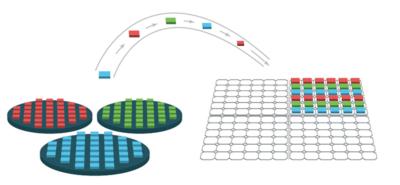
The microLED transfer process is crucial in MicroLED display production, this is likely to be the most challenging part of the entire process. In this article (an excerpt from The MicroLED Transfer Process Report), we'll give an overview of the transfer process, its challenges, and alternatives.

microLED transfer process image

At the beginning of this stage, there's the wafer with the MicroLED chips, and a display substrate with the backplane TFTs on top. As we said, this is a challenging process, and there are three main challenges in this step – accuracy, speed and reliability.

It is important to note that if the display is based on RGB microLED devices, it complicates this step further – which is why many MicroLED makers are expected to adopt blue LEDs with color conversion.

Read the full story Posted: Feb 05,2022 - 4 comments

eLux installs a new automated fluidic assembly R&D tool, unveils a new microLED display prototype

USA-based eLux was established in 2016 as a spin-off from Sharp Labs of America, to commercialize a unique MicroLED production technology. A year ago we discussed the company's technology and business with its CEO, Jong-Jan Lee.

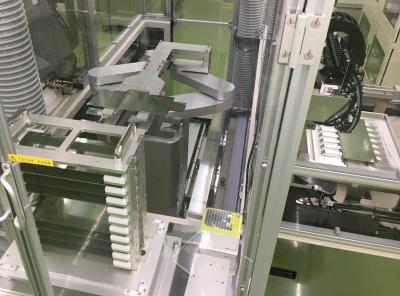
eLux automated fulidic assembly tool, 2021

Today eLux announced that it has installed an automated fluidic assembly tool at its prototype fab in Taiwan. The new tool features fully automatic cassette-to-cassette fluidic assembly of ten display panels, each up to 15-inch in size. The tool has provisions for capture and recycle of microLEDs and assembly fluids to minimize operating costs, and its capacity can be expanded by adding two additional modules.

Read the full story Posted: Apr 20,2021

eLux's fluidic microLED technology and business explained

USA-based eLux was established in 2016 as a spin-off from Sharp Labs of America, to commercialize a unique MicroLED production technology. The company was in stealth mode for a few years, and is now finally discussing its technology and business. We talked to the company's president and CEO Jong-Jan Lee, who explains the company's technology, status and plans.

eLux's technology is based on a unique approach that moves microLEDs from wafer to the target substrate without the need of a pick-and-place process. The so-called fluidic process uses microLEDs dispersed in liquid and wells built onto the substrate. The microLED dispersion is spread over the substrate and the LEDs simply fall into place - a sort of self-assembly process, which can be seen in the video above.

Read the full story Posted: Mar 18,2020