 France-based Aledia, founded in 2011, developed a technology to grow 3D GaN LEDs on 200 mm and 300 mm silicon wafers using CMOS wafer-fabrication processes and tools. Aledia says that its LED chips are 25% cheaper compared to traditional planar LED chips, and these LEDs can be used for micro-LED displays.
Aledia raised over 360 million Euro in total, with the latest 120 million Euro round announced in October 2023. In 2020 Aledia announced that it plans to establish a 140 million euros LED production fab.
Aledia is a MicroLED Industry Association member. The company has over 250 patent families (granted, or in application) and has two nanowire LED platforms. The first is based on blue-emitting 1.2 µm GaN nanowires on 8’’ and 12’’ silicon wafers and QD color conversion, aiming to produce 160µm RGB single-chip LED for fine pitch large-area displays. Aledia's next-generation microLED platform, still in R&D, targeting 2µm full-color RGB LEDs for AR applications.
17 rue des Martyrs
Building M23
38054 Grenoble
France
MicroLED startups raise over $200 million in the past year
In the past year, microLED startups have raised over $200 million. As some companies (most notably Aledia and JBD in this case) mature and start to build production capacity, the need for funds grows, and we have indeed seen large investment rounds in these companies.

- Kubos Semiconductors: $2 million (May 2024)
- MICLEDI: $17 million (March 2024)
- Mojo Vision: $21.1 million (October 2023)
- Aledia: $129 million (October 2023)
- Comptek Solutions: $8.6 million (August 2023)
- QNA Technology: $4 million (August 2023)
- JBD: A4 round, estimated at $30-130 million (June 2023)
It is great to see these recent funding successes, which will hopefully lead to increased innovation and also initial production. It should be noted that most (if not all) of these financing rounds have been finalized before Apple made its decision to cancel its main microLED wearable project. We do not see Apple's decision as having a major impact on the long-term viability of microLED technologies or on the industry - but we do know that some investors are now hesitant to invest in this market following Apple's project cancellation.
Aledia announces the world's most efficient 1.5 micron microLEDs
France-based microLED developer Aledia announced some breakthrough advances. The first one is a new <1.5 um microLED device that has the world's highest EQE of 32%. Aledia says that this new device leads to a Wall Plug Efficiency (WPE) of 320 milliwatts of visible light output per watt of electrical power input.
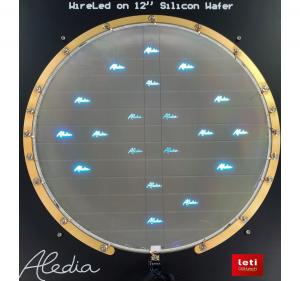
As you can guess from the first subject, Aledia has successfully reduced its microLED pixel size to 2 um, or even below. Finally, Aledia says that it has reached a 99% DCI-P3 color gamut.
Aledia raises €120 million from existing investors as it starts to mass produce microLEDs
France-based microLED developer Aledia has closed a new financing round, raising €120 million from existing investors. The company also appointed Pierre Laboisse as its CEO (Giorgio Anania, the previous CEO, remains on the company’s board of directors).
Aledia's investors include CEA Investissement, Supernova Invest, and the SPI and Ecotechnologies funds. In 2020 Aledia announced that it plans to establish a 140 million euros LED production fab in Champagnier, near Grenoble in France. The company already raised 110 million Euros towards that goal, and now it has raised another significant amount of money. In total, the company raised over €360 million to date.
Aledia, DELO, GE and Smartkem join the MicroLED Industry Association
The MicroLED Industry Association (MIA) welcomes new members GE, Smartkem, DELO and Aledia, joining over 30 existing members (including large corporations, startup companies, research institutes and more). The MIA aims to accelerate the adoption of microLED display technologies, bringing together companies, researchers and organizations active in the MicroLED industry and providing an ideal forum for solving common technology issues, fostering cooperation and sharing relevant information, resources and tools.
The recently joined members commented:
"Aledia joins the MicroLED Industry Association to help promote microLED display technologies and to contribute to solving main roadblocks that slow down the move, including re-thinking displays architectures and concepts".
QustomDot and Aledia to co-develop full color microLED displays
QustomDot announced an agreement with France-based 3D GaN LED developer Aledia to co-develop a full-color microLED displays, based on Aledia's high-efficiency Gan-on-Silicon 3D Nanowire LEDs grown on 300 mm wafers coupled with QustomDot's high performance quantum dots color conversion technology.
QustomDot developed a patented method to produce high-quality and stable QD materials suitable for microLEDs, that are heavy metal free. A few months ago the company announced it is co-developing microLED displays with MICLEDI.
Aledia closes a $30 million financing line from Trinity Capital
Trinity Capital announced that it has closed $30 million equipment financing line for Aledia, which will use the funds to expand its microLED nanowire growth manufacturing facility, and accelerate its product platform and R&D.

Aledia announced in 2020 that it plans to establish a 140 million euros LED production fab in Champagnier, near Grenoble in France. The company already raised 80 million Euros towards that goal, and the new funds announced will add to that.
Aledia produces its first nanowire microLEDs on 300 mm silicon wafers
France-based 3D GaN LED developer Aledia announced that it has produced its first nanowire microLED chips on 300 mm silicon wafers, at the CEA-Leti pilot line. Producing microLEDs on large wafers is more cost effective and will enable integration with smaller-node electronics.
Earlier this year Aledia announced that it plans to establish a 140 million euros LED production fab in Champagnier, near Grenoble in France. The company already raised 80 million Euros towards that goal. The new fab will use Veeco's 300 mm MOCVD systems.
Aledia orders Veeco's 300mm MOCVD systems for its upcoming MicroLED production fab
Veeco announced that France-based 3D GaN LED developer Aledia has selected the company's Propel 300mm HVM MOCVD system for its microLED production plant. Veeco says that the Propel system, featuring a SEMI-compliant Equipment Front End Module (EFEM) with cassette-to-cassette automation, was chosen due to its highest productivity with the lowest defectivity compared to alternatives.
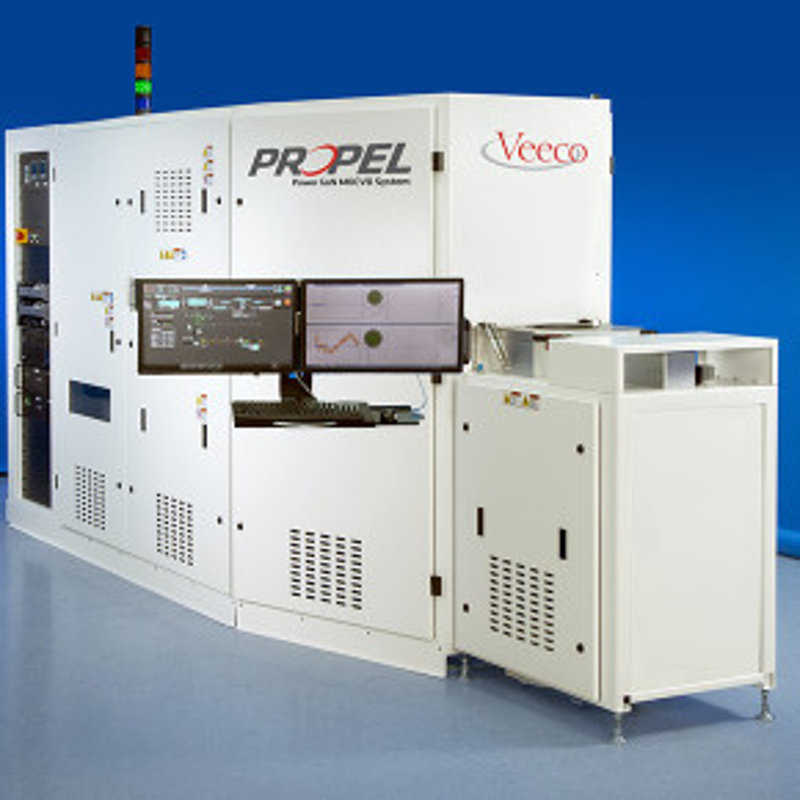
Last month Aledia announced that it plans to establish a 140 million euros LED production fab in Champagnier, near Grenoble in France. The company already raised 80 million Euros and its great to see the company already ordering production equipment.
Aledia raised €80 million towards its mass production microLED fab
Last month France-based 3D GaN LED developer Aledia announced that it plans to establish a 140 million euros LED production fab in Champagnier, near Grenoble in France. Today the company announced that it closed â¬80 million in funding, out of the planned â¬120 million Series D investment round.
The lead investor in this round is the Investment Fund Société de Projet Industriel (SPI), a fund managed by Bpifrance. SPI is joined by the majority of the existing strategic investors, including Intel Capital.
Aledia to setup a 140 million Euros GaN-On-Si microLED production line, start making microdisplay by 2022
France-based 3D GaN LED developer Aledia announced that it plans to establish a 140 million euros LED production fab in Champagnier, near Grenoble in France. The plan is to start LED production by 2022 - and by the company will also finalize its microdisplay production process and will start offering microLED microdisplays.
Aledia developed a microLED production process, based on a unique 3D architecture using GaN-on-silicon nanowires (branded as WireLED).

